Predicting CCS for compounds we have never measured

The previous post ended with a question. We had 247 halogenated features in a single LC-HRMS injection of a real chlorinated surface water. Twelve matched a public database. The other 235, most of them the kinds of disinfection byproducts that water utilities have never been required monitor, sat without a name, a CCS value, or a fragmentation spectrum. The bottleneck, the post argued, was not the instrument. It was the size of the database. We are not under-instrumented. We are under-resolved.
Can we predict the CCS value of a compound we have never measured, well enough to use the prediction as part of an identification filter? In 2026, the honest answer is "yes, for many compounds, with caveats that matter." This post is about what that means in practice.
What ML-for-CCS prediction actually is
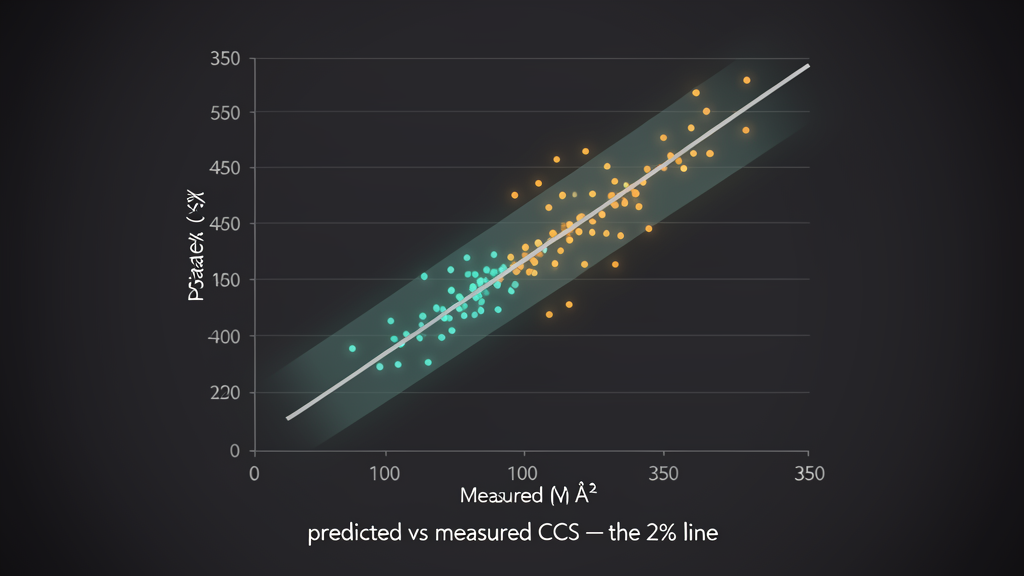
The task is narrowly defined. Given a molecular structure — a SMILES string, a Morgan fingerprint, or a 3D conformer — predict the rotationally averaged collision cross section in a specified buffer gas (N₂ or He) at a defined effective temperature. The training data are measured CCS values from a single instrument or a harmonized multi-instrument set. The output is a single number in square angstroms. The accuracy bar is set by the measurements themselves: a good ML prediction should match a high-quality drift-tube value within the inter-laboratory reproducibility of the measurement, on the order of 1–2%.
The algorithm zoo has settled into two families worth knowing. DeepCCS (Goscinny et al., Analytical Chemistry, 2019) trained a deep neural network on roughly 3,000 measured values and reported a mean absolute error of around 2% on a held-out test set. Graph neural networks, a more recent approach, take the molecular graph directly as input and learn their own descriptors; on sufficiently large training sets they match or beat DeepCCS. SVR and XGBoost on engineered descriptors exist and remain useful when interpretability matters, but the field has moved on.
For compounds inside the training distribution, both families are roughly equally accurate — within a couple of percent of a measured value, comparable to the reproducibility of the measurement. For compounds outside the training distribution — and this matters for the halogenated DBPs the previous post was about — the picture changes.
The case: halogenated DBPs as the natural test
Disinfection byproducts are the perfect stress test for an ML-CCS pipeline. There are thousands of them, structurally diverse: chlorinated, brominated, iodinated, with nitrogenous and oxygenated variants depending on the disinfectant. Most have never been measured. Most never will be — not because the measurements are hard, but because synthesizing and authenticating an analytical standard for every candidate exceeds the budget of any research group now active in the field.
The use case is not "replace measurements." It is "use a predicted CCS as a triage filter in a non-target screening workflow." You have a feature in your LC-HRMS run with measured m/z, retention time, and CCS. You have a candidate structure from a suspect list or a database expansion. If the candidate's predicted CCS matches the measured value within tolerance, the candidate is more credible than on m/z alone. If the predicted CCS does not match, you have learned something useful: either the candidate is wrong, or the model is being asked to extrapolate beyond its training set. Either way, you spend your MS/MS time more efficiently. The previous post's closing question was, in effect, whether this is good enough to act on. The answer is yes for some compound classes, not yet for others, and improving fast.
State of the art: databases and prediction together
Three community resources hold most of the measured CCS values that ML models train on. The Hinnenkamp OMP library (Hinnenkamp et al., Analytical Chemistry, 2021) covers roughly 5,000 organic micropollutants with drift-tube CCS in N₂. CCSbase is a multi-instrument, community-curated database of around 15,000 compounds. The NORMAN Suspect List Exchange is broader — a collection of suspect-screening lists for many compound classes — and includes CCS where contributors have supplied them.
These databases are growing, but the total is small next to the >100 million compounds in PubChem. An ML-CCS model is bounded by its training set: it interpolates well inside the convex hull of molecules it has seen, and extrapolates poorly outside. For a polyhalogenated compound above 500 Da, a zwitterion, a heavily fluorinated PFAS, or any of the chlorinated, brominated, or iodinated DBPs that dominate the analytical signal of a real drinking water — the model is being asked to do something its training set did not really prepare it for. That is the gap that environmental chemists actually need closed.
How good is good enough?
Three benchmarks set the practical ceiling. The inter-laboratory reproducibility of measured CCS, as established by Nürenberg et al. (Analytical Chemistry, 2018), is roughly 1–2% across instruments and laboratories when calibration is harmonized. The best in-distribution ML models match that on held-out test sets. The best out-of-distribution models do considerably worse, with mean absolute errors that can rise into the 5–10% range or higher for compounds with no close training-set neighbor.
The practical rule is split. In-distribution: an ML-CCS match is as credible as a measurement, usable as an identification filter with confidence comparable to a measured value. Out-of-distribution: an ML-CCS match is a hypothesis, not a confirmation. It narrows the candidate list. It does not close it.
Two operational heuristics follow. The first is the "two of three" rule: if m/z, retention time, and predicted CCS all agree on a candidate structure within their respective tolerances, the identification is high-confidence even without an authentic standard. The second is the "fail loudly" rule: a model that does not report uncertainty is dangerous. Without an associated uncertainty, you cannot distinguish a confident identification from a confident hallucination. Bayesian neural networks and deep ensembles report uncertainty; classical regression models can be wrapped to do so. If your model cannot tell you when it does not know, you are using the wrong model.
A worked example: DeepCCS in practice
Goscinny et al. (2019) is the right place to start because it is the most-cited and the most accessible. The training set was roughly 3,000 measured CCS values, dominated by small organic molecules and environmental contaminants measured on a drift-tube instrument. The reported mean absolute error on the held-out test set was about 2%, at the edge of what the measurements themselves can resolve.
For a worked case, take trichloroacetamide — an unregulated haloacetamide, the kind of compound that appears in chloraminated drinking water and does not appear on any regulatory list. SMILES in, predicted CCS out, within the 2% range of a careful drift-tube measurement. If a feature in your LC-HRMS run has a measured CCS that matches the prediction within tolerance, trichloroacetamide is a credible candidate. If the measured CCS is far off, move on.
The model's accuracy is a property of the training set, not of the algorithm. Trichloroacetamide is small and halogenated, close enough to the training distribution for the prediction to be reliable. For a larger, more unusual, more heavily halogenated DBP — say a tetrabrominated haloacetonitrile above 400 Da — the same prediction comes with much larger uncertainty, and the workflow has to treat it as a hypothesis rather than a confirmation. The out-of-distribution failure mode is where the model breaks, and it is the most important class for environmental chemists.
What this changes — and what it doesn't
For in-distribution compounds, ML-CCS prediction moves a non-target screening workflow from "match m/z and retention time" to "match m/z, retention time, and CCS" without requiring an authentic standard for every candidate. That is a real gain. For out-of-distribution compounds — the halogenated DBPs of the previous post, the larger PFAS, the polyhalogenated unknowns — the prediction is still useful as a triage tool, but it is not confirmation. The gap is closing year over year. The compounds we can predict well today are a strict superset of those we could predict well five years ago.
Three questions are still open. For which compound classes are ML-CCS predictions reliable enough to act on, and where do we need new measurements first? Can ML models be made routinely uncertainty-aware, so they can say "I don't know" for out-of-distribution compounds in a way the downstream workflow respects? What does a production workflow look like that combines ML-CCS prediction with measured CCS, MS/MS, and authentic standards in a coherent decision tree?
This is the last post in the first wave of this series. Five posts ago, the opening question was whether a third dimension of separation — collision cross section — was worth the instrument time. The posts that followed argued that it was, that it could resolve isomers other separations could not, that the databases built on it left a real gap, and that the gap could be partially closed by prediction. The series has covered CCS as a tool, the problems it solves, the gaps it leaves, and the predictions that extend it. The work of the next five years will be to make the predictions good enough that the gap closes — and to know, honestly, when it has not.
Further reading
- Goscinny, S. et al. (2019). Prediction of collision cross section values for organic environmental contaminants using a deep neural network. Analytical Chemistry.
- Nürenberg, G. et al. (2018). Comparison of CCS values determined by TWIMS and DTIMS: application to a suspect screening method. Analytical Chemistry.
- Hinnenkamp, V. et al. (2021). Ion mobility–high-resolution mass spectrometry (IM-HRMS) for the analysis of contaminants of emerging concern (CECs). Analytical Chemistry.
- CCSbase project — community CCS database, multi-instrument. ccsbase.net
- NORMAN Suspect List Exchange — suspect-screening lists with CCS where available. norman-network.com
- Plante, P.-L. et al. (2019). Predicting ion mobility collision cross-sections using a deep molecular fingerprint. J. Cheminform. (early GNN-on-fingerprints benchmark)
- Zhou, Z. et al. (2023). Ion mobility collision cross-section prediction using graph neural networks. (review of GNN-era accuracy gains)
- Post 4 of this series — The 70% problem. — for the DBP inventory that motivates the prediction gap.
- Post 1 of this series — What is a Collision Cross Section? — for the basics if you skipped them.