Isomers that poison: when same mass, different shape, different toxicity

In the previous post I described about how chlorination of 6PPD-quinone generates twelve transformation products (TPs), eleven of them chlorinated (Jiao et al., 2026). Eleven chlorinated TPs are not all the same molecule with one chlorine stuck on. They are mostly positional isomers — the chlorine atom is at a different position on the 6PPD-Q scaffold in each one. They have the same exact mass. They have similar chromatographic behavior, and they have measurably different toxicities.
This is the isomer problem, and it is quietly one of the under-appreciated sources of error in environmental toxicology.
Same atoms, different molecules
Isomers are molecules that share a molecular formula but differ in structure. There are three classes that matter for environmental analysis:
- Structural (constitutional) isomers — different connectivity. 1-propanol and 2-propanol are the textbook example.
- Positional isomers — the same groups attached at different positions on a ring or chain. This is the most common class in environmental transformation products: a chlorine atom on carbon-2 versus carbon-3 of an aromatic ring, for example.
- Stereoisomers — same connectivity, different 3D arrangement. Enantiomers (non-superimposable mirror images) and diastereomers (everything else).
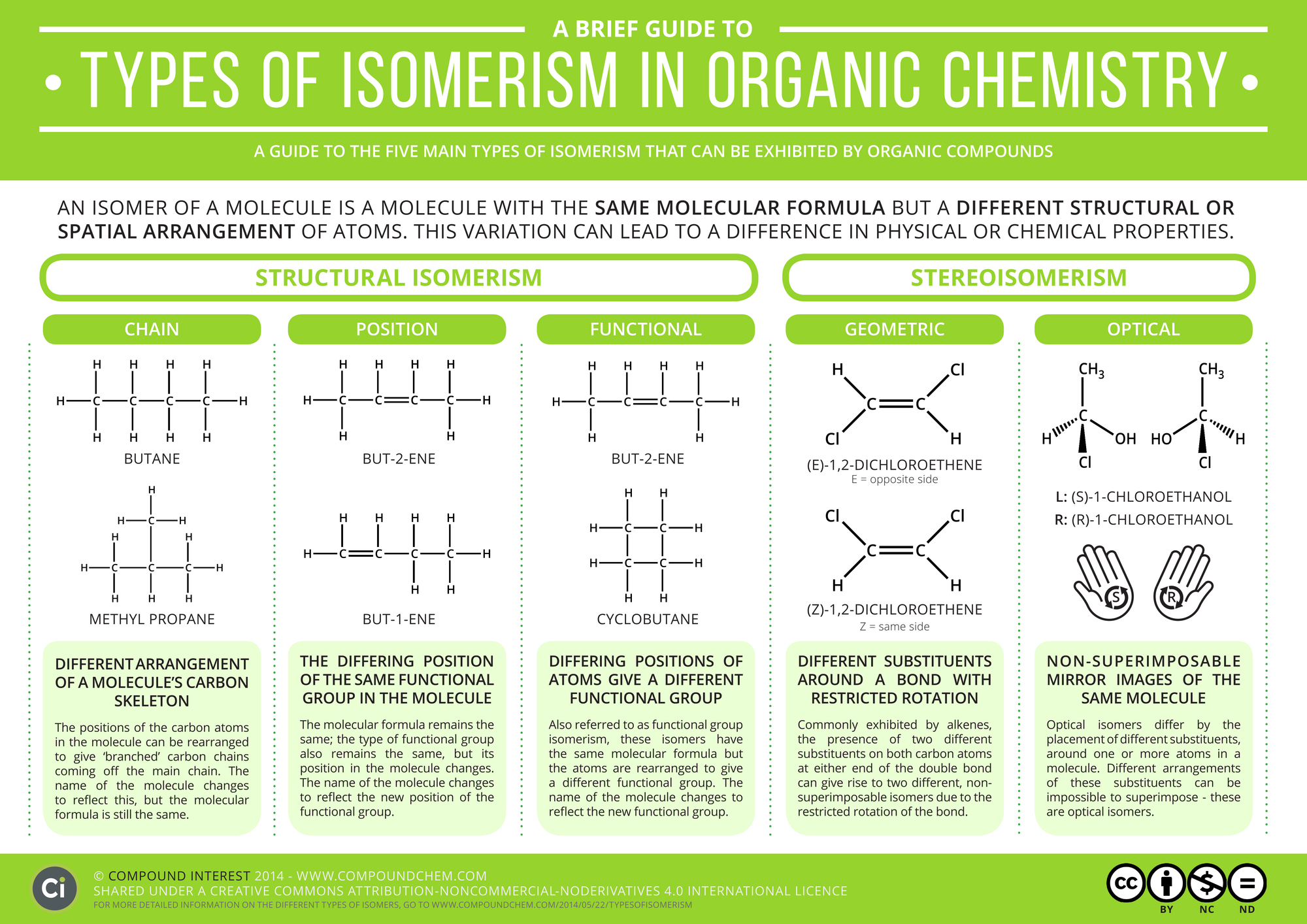
In a standard LC-HRMS workflow, all three classes can give you the same exact mass and a similar retention time. The conventional analytical chemistry convention — "one chromatographic peak at one m/z equals one compound" — silently breaks down for isomers. When you assume that a feature with m/z 299.1234 is a single molecule, you may be wrong in ways that will bite you at the next step, which is usually a toxicological interpretation.
Four examples, all of them in your wastewater
1. 6PPD-Q chlorination transformation products. The case I described in the previous post. The eleven chlorinated TPs of 6PPD-Q are dominated by positional isomers, with the chlorine atom substituting at different positions on either the quinone ring or the p-phenylenediamine moiety. Toxicity increases with the extent of Cl-substitution (the more chlorines, the more toxic to aquatic organisms), and likely depends on substitution position as well. When a routine monitoring campaign reports "6PPD-Q removed by chlorination," it is technically true — but it is not the whole story. The actual toxicological load on the receiving water may be higher than before disinfection.
2. Disinfection byproducts (DBPs). When chlorine, ozone, or chloramine reacts with natural organic matter in source water, the resulting soup of byproducts contains thousands of compounds. The regulated subset — the trihalomethanes (THMs) and haloacetic acids (HAAs) — is a tiny fraction of the total. THMs have four species (chloroform, bromodichloromethane, dibromochloromethane, bromoform), all with the same CHX₃ formula. HAAs have nine chloro/bromo species. There are also haloacetonitriles, halonitromethanes, haloacetamides, and a long tail of unidentified DBPs.
Toxicity varies dramatically across this family. Iodinated DBPs are more cytotoxic and genotoxic than their brominated and chlorinated analogs at the same molar concentration, sometimes by orders of magnitude. A water utility switching from chlorine to chloramine to reduce regulated THMs may inadvertently increase the relative proportion of more toxic nitrogenous DBPs. The "haloacetic acid" measurement lumps all nine species together; the "trihalomethane" measurement lumps all four. The total mass tells you almost nothing about the total toxicological load.
3. Polycyclic aromatic hydrocarbons (PAHs). Sixteen PAHs are on the U.S. EPA priority pollutant list. They have a wide range of structures, but within the family there are some notorious isomer pairs. Benzo[a]pyrene and benzo[e]pyrene share the molecular formula C₂₀H₁₂. They differ in how one benzene ring is fused to the pyrene core. Benzo[a]pyrene is a Group 1 IARC carcinogen — one of the most potent PAHs known — and benzo[e]pyrene is much less so. The regulatory framework uses toxic equivalency factors (TEFs) to weight individual PAHs against benzo[a]pyrene. But those TEFs only work if you can tell the isomers apart in the first place. A measurement of "total PAH" or "BaP-equivalents" without isomer-resolved analysis hides the actual toxic drivers.
4. Per- and polyfluoroalkyl substances (PFAS). The PFAS family has thousands of known compounds. Among the PFOA and PFOS isomers, the linear form and various branched isomers have measurably different toxicokinetics. Branched isomers generally bioaccumulate less and clear faster than the linear form, because the linear chain fits the binding pockets of fatty-acid-binding proteins more efficiently. The relative proportion of linear vs branched isomers in environmental samples is also a fingerprint of manufacturing source: electrochemical fluorination (the older 3M process) produces roughly 70–80% linear isomers, while the modern telomerization process produces essentially 100% linear. Source apportionment, and accurate exposure reconstruction, depend on resolving those isomers.
The silent error in environmental toxicology
The common thread across these examples is that the measured compound is often an unresolved mixture. The reported toxicity of "X at Y µg/L" is in many cases the toxicity of an isomer mixture whose composition is unknown. The published structure–activity relationships and toxic equivalency factors are anchored to specific isomers, but the analytical measurements that feed them often cannot resolve the isomers in real environmental samples.
This is not a random error. It is a systematic error class. Studies that fail to resolve isomers systematically over- or under-estimate toxicity, and the direction of the bias depends on the actual isomer ratio in the sample — which in turn depends on the source, the environmental conditions, and any transformation steps the sample has been through.
A 6PPD-Q sample before chlorination has a different isomer profile than a sample after chlorination. A stormwater sample from a road with mostly modern tires has a different PFAS-isomer ratio than a sample from a road with older ECF-produced tires. These are not subtle effects; they can flip a compound's risk category.
The analytical fix: a third dimension of separation
In the first post of this series, I described collision cross section — the third dimension of molecular identification, complementary to m/z and retention time. For the isomer problem, CCS is the single most useful tool that has come into environmental analysis in the last decade. Positional isomers of the same compound (e.g., 2-chloro-6PPD-Q vs 3-chloro-6PPD-Q) typically have measurably different CCS values, often by 1–3% — well within the resolving power of modern drift-tube instruments. Stereo- and structural isomers of environmental contaminants, where measured, almost always show distinct CCS values.
The practical workflow for an isomer-resolved environmental analysis is now reasonably mature. You run your sample on an LC-IM-HRMS platform, with a CCS database for the target isomers in your chemical class. You use the database lookup as an identification filter: features that match m/z and RT and CCS within tolerance are assigned with high confidence; features that match only m/z get flagged as candidates.
The bottleneck is that the CCS databases are still tiny compared to the chemical universe (more on that in the next post). For most environmental isomers of interest, the CCS value has not been measured — and may never be measured experimentally, for lack of authentic standards.
Further reading
- Tian, Z. et al. (2021). A ubiquitous tire-rubber-derived chemical induces acute mortality in coho salmon. Science.
- Hu, X. et al. (2024). Transformation of 6PPDQ during disinfection: kinetics, products, and eco-toxicity assessment. Water Research.
- Richardson, S. D. et al. (2007). Occurrence, formation, and health effects of disinfection by-products in drinking water. Mutation Research.
- Plewa, M. J. & Wagner, E. D. (2015). Comparative mammalian cell cytotoxicity of water concentrates from disinfected surface waters. Handbook of Environmental Chemistry.
- IARC Monographs — Benzo[a]pyrene (Vol. 100C, Group 1).
- Benskin, J. P. et al. (2010). Isomer profiling of perfluorinated substances as a tool for source tracking. Environmental Science & Technology.